Claims Visibility API
Get claim status, payment and EOB information directly from the payer through a single API, without manually checking payer portals.
Zuub’s Claims Visibility API retrieves post-submission information from payer portals and standardizes it for use in your product and workflows.
A claim status like pending, in process, paid or denied may tell you where a submitted claim stands, but not everything you need to understand what happened or what needs attention next.
Important details may live inside payer portals and EOBs, including service-level outcomes, payment information and denial details. Getting that information can require teams to check payer portals, retrieve EOBs and manually piece together the information needed for follow-up and reconciliation.
Claims Visibility brings that information into a standardized API response, so your product can give users more visibility into what happens after submission.
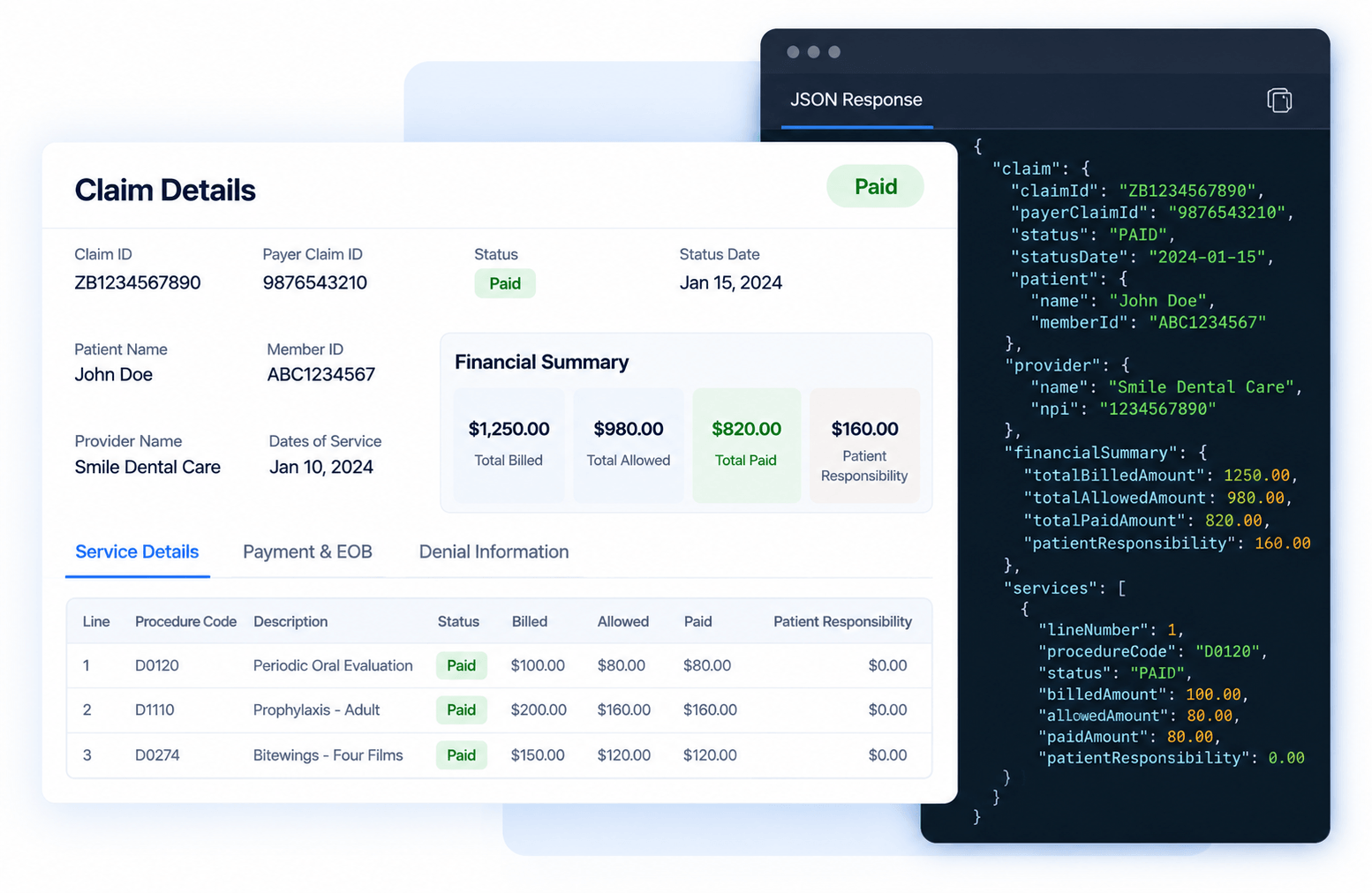
Claims Visibility is built for dental technology companies and RCM organizations that want to bring post-submission visibility into their own products and workflows.
Bring structured post-submission information into the workflows your product already supports.
Bring claim status and supporting information into follow-up workflows.
Use service-level outcomes and denial information to understand what was denied and what may need attention.
Connect claim-level paid amounts with check or EFT information to support reconciliation.
Bring EOB information into your product without requiring teams to manually retrieve it from payer portals.
Use standardized post-submission information to power work queues, alerts, reporting and other workflows.
Zuub manages the payer portal access, retrieval and data standardization behind Claims Visibility, so your team can integrate once and build the post-submission experience into your product.
Zuub connects directly to payer portals to retrieve information about submitted claims.
Claim status, payment details and EOB information are retrieved and structured for use in your product.
Payer-specific information is interpreted and standardized into a consistent structure your product can use.
Structured post-submission information is delivered through a single API for use in your product and workflows.
Bring structured post-submission information into your product through an API without building and maintaining the payer portal retrieval layer yourself.
Submit the information required to locate a specific submitted claim within the payer system.
Receive standardized claim-level, service-level and payment information.
Return and distinguish multiple claim records and their individual statuses when a visit results in more than one claim.
The best way to know whether Claims Visibility fits your product is to evaluate it against the payers and post-submission information your workflows need.
Evaluate status detail, service-level information, denial detail, payment information, EOB support and data structure against your actual requirements before moving into production.
A Claims Visibility API gives dental technology and RCM products access to information directly from the payer about what happens after a claim is submitted, including claim status, payment and EOB information.
No. Claims Visibility is a post-submission product. It retrieves information directly from the payer about submitted claims and makes that information available through an API.
Basic claim status tells you where a submitted claim stands. Claims Visibility can also provide additional information directly from the payer, including service-level outcomes, payment information, denial details and EOB information.
Claims Visibility can return the paid amount associated with an individual claim as well as check or EFT information. Your product can use that information to support reconciliation workflows.
Claims Visibility can retrieve and structure EOB information. Payer and EOB support relevant to your product can be validated during evaluation.
Bring post-submission information directly from the payer into the workflows your product already supports.